

ADHD and Naps: Why You Crash at 2 p.m. and What the Nap Is Telling You
You set the alarm for twelve minutes.
You are parked outside the school, or the office, or the grocery store you have not gone into yet, and you have reclined the seat as far as it goes. You are not going to tell anyone about this. Not your partner, who thinks you slept fine. Not the friend who asked how you were doing. Definitely not the coworker who came back from lunch and just kept working, the way people apparently do.
You slept eight hours. You are doing everything right. And your body has decided, at two in the afternoon, that it is finished.
If that is you in the car, you are not lazy, and you are not broken. Your brain is running a specific kind of debt, and the nap is the bill arriving.
What it is: Adults with ADHD nap more than they expect to, usually because of three things stacking: a body clock that runs late, the cognitive cost of forcing attention all day, and the window where stimulant medication wears off.
What it costs: Hours you did not plan for. Naps taken in secret, in cars and bathrooms and parked lots. Evenings that start at 7 p.m. because the afternoon disappeared. And the running commentary that says a person who slept eight hours should not need this, which turns a physiological event into a character verdict.
Why "stop napping and fix your sleep hygiene" is bad advice: It treats the nap as the malfunction. The nap is a readout. A short one genuinely restores executive function; a long or late one deepens the delayed body clock that caused the exhaustion. Read the signal, then set length and timing around it. And if you cannot get through a day without sleeping, that is a reason to be evaluated by a sleep physician, not a reason to try harder.
↓ Keep reading for the three mechanisms behind the afternoon wall, what the medication crash window actually does, and how to nap in a way that does not cost you tonight.
At Brilla Counseling in Sacramento, sleep is one of the first things we ask about, because it is the thing clients apologize for most. Since 2020, working with women and adults with ADHD in our East Sacramento office and by telehealth across California, we have watched the same conversation happen: someone describes a napping habit in the tone people use to confess something, and then seems surprised that the answer is a set of questions about their body clock rather than a lecture about discipline.
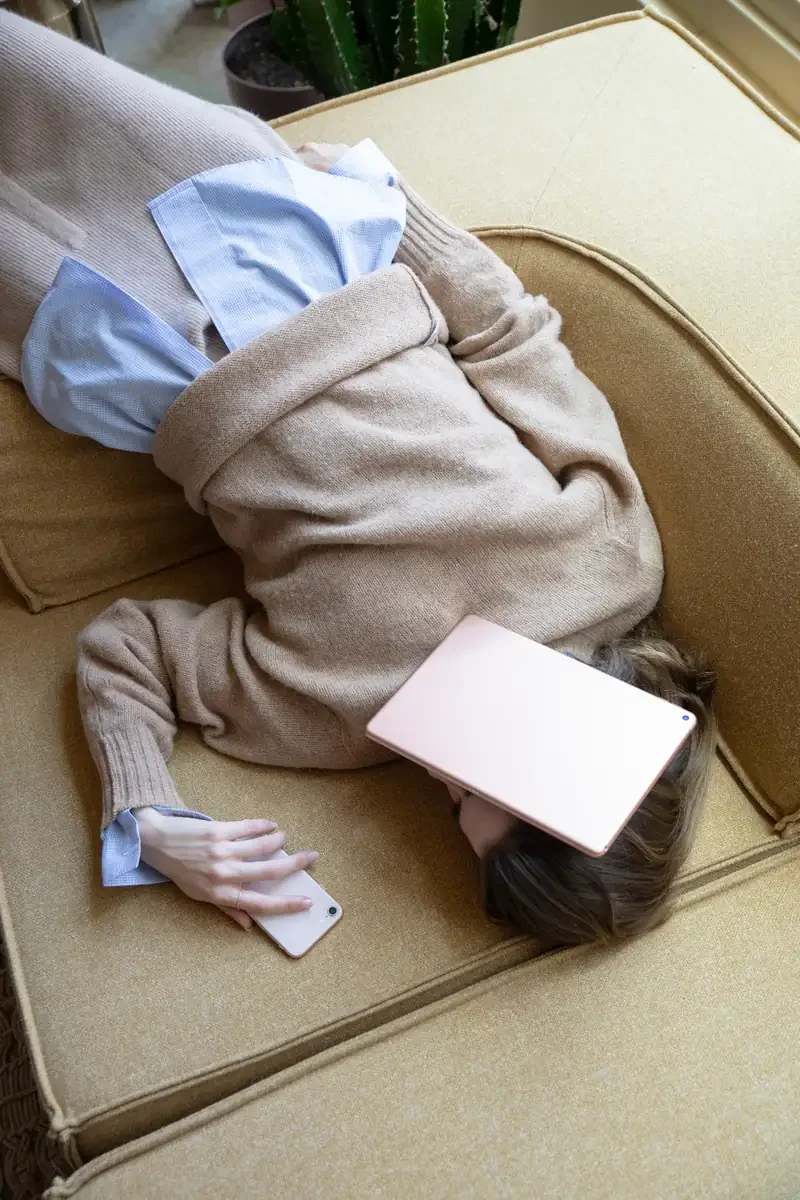
Phone still in hand. The nap was not on the schedule.
What is actually happening when an ADHD brain needs a nap?
Sleep pressure meeting a depleted system. Napping is not an ADHD symptom in the diagnostic sense. It is what happens when a brain that already works harder to sustain attention reaches the end of what it has, on top of a night that was probably shorter than it looked.
Three things tend to be running at once. Your internal clock is set later than your calendar is. You spent the morning generating focus manually instead of receiving it automatically. And if you take stimulant medication, there is a window in the afternoon where the support drops away and your baseline is waiting underneath it.
None of those are habits. All of them are adjustable once you can see them.
You slept eight hours. So why does 2 p.m. still flatten you?
Because the eight hours were probably not eight. You have likely been told that if you are tired, you need better sleep hygiene, more exercise, and less screen time before bed. We want to complicate that, because for most adults with ADHD the problem is not sleep quality in the abstract. It is that the body clock runs late and the alarm does not care.
Delayed sleep phase is the single most common sleep disturbance in adults with ADHD. Reviewing the evidence in the Journal of Neural Transmission , Bijlenga and colleagues put the figure at roughly 73 to 78 percent of children and adults with ADHD showing a delayed sleep-wake cycle, against a general-population range in the low single digits. Your melatonin release is late. Your sleep drive arrives at midnight or later, regardless of how tired you felt at nine.
So you fall asleep at 1 a.m. and get up at 6:30. You call that eight hours because you were in bed for eight hours. It was five and a half. Do that Monday through Friday and by Wednesday afternoon you are carrying a deficit that requires a nap.
In addition, attention you have to manufacture, hold in place, and rebuild every time it slips is expensive, and you have been paying that price all morning. This is the same problem behind why rest often does not fix ADHD burnout . The tiredness is real, and it is not proportional to what you visibly did.
Do people with ADHD nap more than other people?
Often, yes. Adults with ADHD report more daytime sleepiness than adults without it, which follows directly from chronically short nights and the effort cost of sustained attention. It is not a separate mystery requiring a separate explanation.
What matters more than the frequency is the trajectory. Napping two afternoons a week after bad nights is one picture. Napping every single day, on schedule, whether or not you slept well, is a different picture, and one worth taking to a doctor about. More on that below, because it is the part most articles skip.
What happens when your stimulant wears off?
The scaffolding comes down. If you take a stimulant, there is a predictable stretch in the afternoon or early evening where the medication clears and you land back on your untreated baseline while still being awake and expected to function. People describe it as a wall, a crash, or having nothing left to walk on.
Whether that window is a dosing question, a timing question, a formulation question, or just what your day looks like is a conversation for your prescriber. We are therapists. Brilla does not prescribe or manage medication, and we do not do medication evaluations. What we can tell you is that the crash is a known and discussable phenomenon, that "I nap every day at four" is useful clinical information rather than an embarrassing admission, and that many people find the picture changes once timing gets adjusted. If it helps to go in with a framework, our page on medication for ADHD covers what these conversations usually involve.
One thing worth tracking before that appointment: write down the clock time the wall arrives, for two weeks. Not how it felt. The time. A prescriber can do something with 3:45 every weekday. "Afternoons are rough" is harder to work with.

Three years spent optimizing your nap window
Why won't your brain stop talking to itself when you try to sleep?
Because nothing is competing with it anymore. You are exhausted, you lie down, and the volume goes up. Every conversation from today gets replayed with better dialogue. Tomorrow gets rehearsed. A thing you said in 2017 gets a full review.
All day, external demands were pulling your attention outward and drowning that channel out. Take the demands away and there is no longer anything louder than your own mind. That is not anxiety appearing out of nowhere, though it can absolutely tip into anxiety. It is an understimulated brain reaching for the only input still available, which is itself, and this is the mechanism we unpack in more depth in why your ADHD brain won't close the tab at night.
Two things reliably help. Give the channel something to do that is boring but occupying: a podcast you have heard before, an audiobook you know the ending of, low background noise. And stop trying to sleep. Trying to sleep is an effortful task, which is the opposite of what you need. Lying down with no requirement to fall asleep is genuinely restorative on its own, and it removes the failure condition that keeps you awake.
Which kind of tired is this?
Different women land in different versions of this. See if one of these is yours.
The reliable wall. Fine until a specific hour, then not fine, at the same hour most days. This is the one that most often points at medication timing or a fixed sleep debt.
The post-social collapse. You are functional right up until the meeting or the dinner ends, and then you need to lie down immediately. This is the cost of sustained performance coming due, and it belongs in the same conversation as ADHD masking.
The nap you cannot stop. You meant twenty minutes. It was two hours. You wake up disoriented, slightly nauseated, and you have lost the evening. That is not weakness of will; it is sleep depth plus an alarm you slept through, and it is fixable with setup.
The tiredness that never lifts. You wake up tired, you nap, you wake up tired, you sleep at night, you wake up tired. This one is the flag. Skip to the section on when to see a doctor.
The 4 p.m. that eats the calendar. You know the afternoon is a loss, so you stack everything into the morning and then feel behind by noon. This gets tangled up with time blindness, because a day that only has a usable morning in it is much shorter than the day you planned.
Are naps good or bad for ADHD?
Both, and length decides which. A short nap can genuinely restore alertness and executive function. A long or late one borrows from tonight and hands you the same problem tomorrow, slightly worse. Here is how to stay on the useful side of that line.
- Cap it at ten to twenty minutes. Short enough that you stay in light sleep and surface cleanly. Long enough to take the edge off. This is the version that gives you your afternoon back rather than trading it away.
- Take it before three o'clock where you can. The later you sleep, the more it eats into tonight's sleep pressure, and with a body clock that already runs late, you cannot afford to push bedtime further out.
- If you go long, go all the way to ninety minutes. Twenty minutes or a full cycle. The forty-five-minute nap is the one that leaves you wrecked, because you are being dragged out of deep sleep partway through.
- Set two alarms and put one across the room. Not a discipline fix. A design fix. You are asleep at the moment the decision gets made, so the decision has to be made in advance by someone with more leverage than sleeping you.
- Do it lying down, in the dark, deliberately. The nap you take face-down on the couch with the TV on at 6 p.m. is not restorative and it does wreck your night. A planned nap and an accidental collapse are different events with different consequences.
- Watch the caffeine you use to avoid napping. A 4 p.m. coffee taken to skip a nap pushes your sleep onset later, which is the exact mechanism generating the deficit. Sometimes the twenty-minute nap is the cheaper purchase.
- Anchor your wake time before you touch anything else. With a delayed clock, a consistent wake time does more than a consistent bedtime, because your bedtime is largely not under your control and your alarm is.
- Track it for two weeks before changing anything. Time you woke, time the wall hit, length of the nap, how you felt after. Two weeks of that is more useful to a doctor or therapist than a year of trying to fix it in your head.
When is daily napping a reason to see a doctor rather than fix your habits?
When you cannot get through the day without it. This is the paragraph that matters most in this post.
Persistent excessive daytime sleepiness despite adequate sleep is also the presenting picture for obstructive sleep apnea, narcolepsy, and idiopathic hypersomnia. ADHD co-occurs with all three, and the overlap runs both directions: an exploratory study in Sleep Science and Practice found that patients with narcolepsy or idiopathic hypersomnia screened positive for inattention and hyperactivity on an ADHD self-report scale, meaning these conditions are genuinely mistakable for each other. Long, unrefreshing naps and waking up groggy after a full night are recognized features of hypersomnolence disorders, not just of a hard week.
Raise it with a doctor and ask about a sleep evaluation if any of these are true: you sleep a full night and are still sleepy the next day, you snore or have been told you stop breathing, you nod off without intending to, your naps are long and leave you unrefreshed, or the sleepiness has been there for months and is not tracking with your workload. The clinical review of excessive daytime sleepiness in Mayo Clinic Proceedings lays out the standard workup, and it starts with a conversation, not a lab.
We are saying this plainly because the alternative is worse. If you already believe your tiredness is a personal failing, you are exactly the person who will spend three years optimizing a bedtime routine instead of getting a sleep study. Attributing everything to ADHD is its own kind of missed diagnosis.
If you have been managing the afternoon wall by hiding it, and the hiding has become its own job, that is a reasonable thing to bring into a first conversation. Reach out for a free 20-minute consultation.
What are you really asking when you ask whether it's okay to nap?
Almost nobody arrives at this question neutrally. Watch what tends to sit underneath it.
Whether you are allowed. The question is usually a physiological one that is asked as permission. Somewhere along the way you learned that a competent adult produces energy on demand, and the nap reads as evidence against you.
Whether this is the beginning of something. People notice the napping and quietly wonder whether it means they are declining, or depressed, or losing the thing that let them keep up. Naming that fear is useful, because it is answerable. Some of the answers are medical, some are about load, and almost none of them are about your worth.
Whether you have to keep paying this much. The nap is often the first place the total cost of running compensatory attention all day becomes visible, because it is the first cost that shows up on the calendar. Everything else was absorbed silently. This one takes ninety minutes and everyone can see it.
Whether anyone would believe you. Fatigue is invisible and unprovable, and if you have spent years being described as dramatic or lazy, you may have stopped mentioning it at all. That silence is expensive, and it is frequently part of the picture in a late ADHD diagnosis.
The nap is not the thing to fix
Somewhere in this you may have decided that the goal is to become a person who does not need naps. We would gently put that goal down.
The goal is a day that your actual brain and body can get through without secret arrangements. Sometimes that includes a deliberate twenty minutes with the door shut, and that is not a concession. It is maintenance, the same way anyone else's coffee break is maintenance, except yours has a bad reputation.
Self-trust here looks like believing your own tiredness the first time it reports in, instead of running it past a committee. You are allowed to be a person with a specific energy shape. Healing does not have to look neurotypical, and it definitely does not have to look like staying vertical for sixteen hours to prove a point.

Too tired to read the same line a fifth time, too wired to actually sleep.
Frequently asked questions
Do people with ADHD nap more than other people?
Often, yes. Adults with ADHD report higher rates of daytime sleepiness than adults without ADHD, largely because delayed sleep phase shortens their nights and sustaining attention costs them more energy during the day. Research reviewing sleep in ADHD estimates that roughly 73 to 78 percent of children and adults with ADHD have a delayed sleep-wake cycle, compared with a low single-digit rate in the general population. The napping is usually a downstream consequence of that, not a separate trait.
Are naps good or bad for ADHD?
Good when they are short, bad when they are long or late. A ten-to-twenty-minute nap can restore alertness and executive function without cutting into your sleep pressure for the night. A ninety-minute nap at five in the afternoon pushes your bedtime later, which deepens the delayed sleep phase that caused the exhaustion in the first place. Length and timing decide which one you get.
How long should an ADHD nap be?
Ten to twenty minutes, ideally before three in the afternoon. That range keeps you in lighter sleep so you wake up clear rather than groggy. If you know you need more, a full ninety-minute cycle is a better choice than forty-five minutes, because waking mid-cycle out of deep sleep is what produces the heavy, disoriented feeling afterward.
Why do I need a nap every day all of a sudden?
A sudden change is worth investigating rather than absorbing. Common causes include a shift in sleep timing, a change in medication or dose, a period of higher cognitive or emotional load, illness, or hormonal changes. If the daily napping is new, persistent, and not tracking with anything obvious in your life, bring it to a doctor. Excessive daytime sleepiness that appears without a clear explanation is a medical question first.
Can I nap on stimulant medication?
Many people can, and some find it easier than expected once the medication has cleared. Stimulants affect people differently, and how a nap interacts with your dose, formulation, and timing is specific to you. This is a question for your prescribing provider, not something to work out by trial and error. Brilla provides therapy and assessment and does not prescribe or manage medication.
Why do naps leave me more disoriented than rested?
Usually sleep inertia. Waking out of deep sleep produces temporary grogginess, slowed thinking, and disorientation that can last from a few minutes to an hour, and it is more pronounced after longer naps and when you are already sleep-deprived. Keeping naps under twenty minutes usually avoids it. Long naps that consistently leave you unrefreshed, however, are also a recognized feature of hypersomnolence disorders and are worth raising with a doctor.
What this means for you
- The afternoon wall is arithmetic, not attitude. Late body clock plus short nights plus the effort cost of manufactured attention produces a predictable deficit. It arrives on schedule because the causes are on schedule.
- Short naps help, long ones charge interest. Ten to twenty minutes before 3 p.m. restores something. Ninety minutes at five borrows it back from tonight.
- Track the clock time, not the feeling. Two weeks of "the wall hit at 3:45" is the single most useful thing you can hand a prescriber or a therapist.
- Wake time is the lever you actually control. With a delayed clock, anchoring when you get up moves more than trying to legislate when you fall asleep.
- Daily unavoidable napping is a medical question. Sleep apnea, narcolepsy, and idiopathic hypersomnia all present this way and all co-occur with ADHD. Ask for a sleep evaluation rather than another round of sleep hygiene.
At Brilla, we think the woman asleep in her car has already been managing this competently for years, mostly alone and mostly in secret. The work is not teaching her to need less rest. It is getting the arrangement out of the parking lot and into her actual life, where it can be planned for instead of hidden.
If the afternoons have been costing you more than you have told anyone, that is a fine place to start. Individual therapy for women with ADHD and individual therapy for adults with ADHD are both available in East Sacramento and by telehealth across California. And if you want to keep reading first, ADHD burnout at work and ADHD and emotional regulation cover what the depletion does once it stops being only about sleep.
