
ADHD Paralysis: Why You Freeze Hardest on the Things That Matter Most
You've cleared the whole afternoon for it. The thing you actually care about — the application, the painting, the message you've been meaning to send someone you love, the project that's been living in your chest for months. This is the day. You sit down. And then you don't move.
You answer three emails that didn't need answering. You reorganize a drawer. You watch the cursor blink. Some part of you is screaming this is the one thing you wanted, why can't you just start, and the more it screams, the more stuck you get. By evening, the afternoon is gone and the thing is exactly where you left it, and now there's a fresh layer of shame on top of it.
Here's what almost nobody tells you: you don't freeze like this on things you don't care about. The junk mail gets dealt with. The tasks that mean nothing to you get done, eventually, joylessly. It's the ones that matter — the ones with your whole heart attached — that lock you in place. If that sounds familiar, you're not looking at a motivation problem. You're looking at ADHD paralysis, and it may be running in the exact opposite direction from what you've been told.
What it is: The frozen, can't-start feeling that hits when an ADHD brain faces a task — not because you don't care, but often because you care too much and can't convert that importance into action.
What it costs: The projects closest to your heart sit untouched the longest. You watch yourself avoid the exact thing you wanted, do easier things instead, and feel the shame pile up. Over time you start to believe you're lazy, self-sabotaging, or incapable of wanting things "correctly."
Why "just break it into smaller steps" is incomplete advice: Smaller steps assume the ignition works and the problem is size. Often the real block is the emotional stakes of starting something that matters. The move that helps is lowering those stakes — willingness over force, letting "I should be able to just start" be a thought you have instead of an order you obey.
↓ Keep reading for why paralysis tracks meaning, what's happening in the brain when you freeze, and six moves that actually help an ADHD brain start.
At Brilla Counseling in Sacramento, we specialize in helping women with ADHD get unstuck without white-knuckling it. In over a decade of clinical work with neurodivergent adults — in our East Sacramento office and via telehealth across California — we've watched the same pattern surface again and again: the tasks a woman avoids hardest are almost never the ones she cares about least. They're the ones she cares about most.

Every page is urgent. That's exactly why none of them get picked up.
What is ADHD paralysis?
A frozen, can't-start state. ADHD paralysis is the experience of being mentally or physically stuck in front of a task or decision, unable to begin even when you want to, understand the task, and have the time. It isn't a clinical diagnosis in the DSM-5 — it's a term the ADHD community uses to name something very specific that a lot of people live with.
What separates it from ordinary procrastination is the wanting. In regular procrastination, you dodge a task in favor of something more pleasant. In ADHD paralysis, you can be desperate to do the thing, doing nothing enjoyable instead, and still completely unable to start. People often describe it as an invisible wall between them and the action, or like pushing two magnets together that keep repelling — the harder you push, the harder it pushes back.
It usually shows up in three overlapping flavors. Task paralysis is freezing in front of a specific thing you need to do. Mental paralysis is shutting down under a flood of thoughts, feelings, or stimuli. Choice paralysis — sometimes called analysis paralysis — is stalling because there are too many options and no clear entry point. Most people who live with this recognize all three, often in the same afternoon.
Why do you freeze hardest on what matters most?
Because meaning raises the stakes. This is the part most articles miss. The standard story says paralysis comes from tasks that are boring, vague, or overwhelming — and sometimes it does. But many people with ADHD notice the opposite pattern too: the freeze gets worse as the task gets more important, not less.
There's a logic to it. When something genuinely matters to you, starting badly carries a cost. The blank page for the novel you've always wanted to write is scarier than the blank page for a form nobody will read. The message to the person you love has more riding on it than the reply to a group chat. The more you care, the higher the emotional price of doing it imperfectly — and an ADHD nervous system that already struggles to convert intention into action struggles even more when the intention is loaded with meaning.
We want to name what this is, gently, because you've probably been told the opposite. You've been told you freeze because you're lazy, or because deep down you don't want it badly enough. We want to challenge that directly. The freeze on the things you love isn't evidence that you don't care. It's evidence that you do — so much that your system treats starting as a threat. That's not a character flaw. That's caring, running through a brain that has trouble turning caring into motion.
If this is landing a little too close to home, you don't have to untangle it alone. We work with women who freeze hardest on the things they want most. Reach out for a free 20-minute consultation.
It's a wiring difference, not a willpower gap. ADHD involves real, measurable differences in the brain systems that handle starting, planning, and following through. According to PubMed, a meta-analysis of 83 studies found that people with ADHD show consistent weaknesses across executive function tasks — including response inhibition, working memory, and planning — though the authors are careful to note these deficits are one important component of ADHD rather than the whole story ( Willcutt et al., 2005 ). Executive function is the machinery that gets you from "I intend to do this" to "I am doing this." When it runs differently, the gap between intention and action widens.
Underneath that sits a motivation system that works differently too. Based on articles retrieved from PubMed, brain-imaging research has found reduced function in the dopamine reward pathway in adults with ADHD, and this reduction was associated with lower measured motivation ( Volkow et al., 2010 ). A related imaging study found lower dopamine synaptic markers in the reward pathway of adults with ADHD, tracking with symptoms of inattention ( Volkow et al., 2009 ). In plain terms: the ADHD brain often has less of the chemical signal that says go — so the ignition that fires easily for a neurotypical brain can stall for yours, especially when a task doesn't offer immediate reward or when the emotional stakes are high.
This is why "just try harder" misses. Trying harder is an instruction aimed at a willpower problem. What's actually happening is closer to a high-performance engine with a faulty transmission — the power is real, but getting it to move you forward is the part that doesn't work smoothly. You don't need more effort poured into a system that isn't responding to effort. You need a different way in.
Where you might recognize it
Paralysis doesn't look the same for everyone, and it rarely announces itself. If you see yourself in any of these, you're not imagining it.
The dream project that never starts. The thing you'd call your real work — the business, the book, the art, the cause. It matters more than anything on your to-do list, and it's the thing you touch least. Every day you don't start adds weight, and the weight makes starting harder.
The two-minute task you've avoided for weeks. The phone call. The email. The appointment. It would take almost no time, which somehow makes the not-doing feel more shameful. The size of the task and the size of the freeze have nothing to do with each other.
The important conversation. The message to someone you love. The hard thing you need to say. Because the relationship matters, the stakes of saying it wrong feel enormous — so it sits in drafts, or in your head, unsent.
The competent-at-work, frozen-at-home split. You can run a complex project for your job and then be unable to schedule your own doctor's appointment. This isn't a contradiction. Work often has external structure, deadlines, and other people watching; the things that are just for you have none of that scaffolding.
The hobby you love and keep avoiding. You bought the supplies. You cleared the time. And you keep not doing the thing you supposedly do for joy — because somewhere along the way it stopped being low-stakes and started being something you might do "wrong."
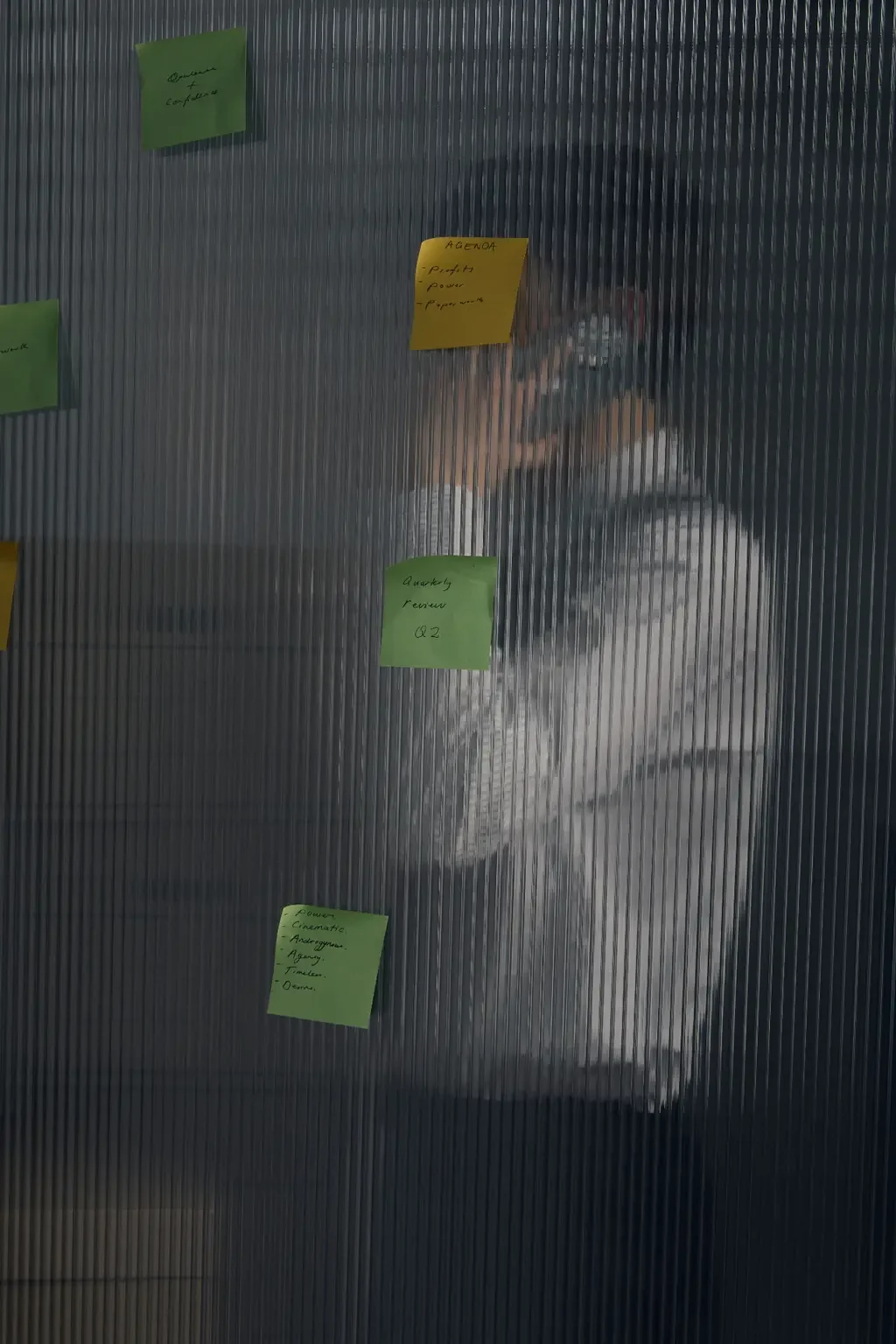
The agenda is right there. You're the one behind the glass.
Six ways to work with ADHD paralysis
None of these is about forcing the freeze to break. Forcing it usually feeds it. These are about lowering the stakes and the activation cost enough that your body can move. Each assumes you've already been trying hard.
- Name the freeze without judgment. Notice you're in it and say so plainly: "I'm in paralysis. This is my brain, not my character." Naming it puts a sliver of distance between you and the stuck feeling, and it interrupts the shame spiral that makes paralysis worse. You're not failing. You're stuck, and stuck is a state, not an identity.
- Separate the caring from the doing. When the task matters enormously, remind yourself that the size of your care isn't something you have to prove by starting perfectly. You're allowed to want something deeply and begin it clumsily. The goal isn't a worthy start. It's any start.
- Lower the stakes on purpose. If meaning is what's freezing you, take some meaning off the table. Give yourself permission to make something bad — set a timer for the "worst draft anyone has ever made." When the outcome is allowed to be terrible, the ignition threshold drops, because there's nothing left to protect.
- Practice willingness instead of force. This comes from Acceptance and Commitment Therapy, and it's the opposite of white-knuckling. Willingness means letting the discomfort of starting be present while you move anyway — not waiting for the resistance to disappear first. You don't have to feel ready. You have to be willing to feel unready and take one step. Research on ACT-based approaches for ADHD is still developing, but the core skill — unhooking from thoughts like "I should be able to just start" so they stop running the show — is one many people find genuinely loosens the freeze ( ACT-based RCT, 2025 ).
- Make the first move physical and almost nothing. Not "work on the novel" — open the file and type one sentence you fully intend to delete. Not "clean the kitchen" — put one dish in the sink. And if the freeze is sitting in your body, move your body first: stand up, walk to another room, come back. You're not trying to feel motivated. You're breaking physical inertia so the smallest action has somewhere to land — and once you're moving, moving tends to continue.
- Get support built for this kind of stuck. You don't have to generate all the structure yourself. Body doubling — having another person present while you work, even on something unrelated — lends your brain external structure it can't make on its own; there's more in our piece on body doubling for ADHD . A conversation with a prescriber about medication can help too, since it can affect task initiation directly — that's a decision for you and your medical provider. And working with a clinician who understands ADHD, through an approach like ACT for ADHD , builds the task-initiation and self-compassion skills that make starting less costly over time.
You've been managing this on your own for a long time. You don't have to keep doing that. Book a free 20-minute consultation and we'll figure out what's actually freezing you.
In more than a decade of sitting with women who freeze like this, we've learned that "how do I make myself start" is almost never the real question. It's the top layer. What actually holds the freeze in place usually lives a few feet below it.
You're afraid that if you start, you'll find out you're not good enough. As long as the dream project stays unstarted, it stays perfect and possible. Starting risks discovering that the real thing won't match the version in your head. The freeze protects the fantasy — and it costs you the actual work.
You've absorbed years of being called lazy. If you spent your whole life being told you weren't trying hard enough, the freeze doesn't just stop you — it confirms the story. Every stuck afternoon feels like proof the critics were right. That internalized voice makes the paralysis heavier than the task ever was.
You've stopped trusting yourself to follow through. After enough unfinished things, you start bracing for your own failure before you begin. The bracing is part of the freeze. Rebuilding trust in yourself isn't about never freezing again. It's about learning that a stuck day doesn't erase you.
You think the wanting should be enough to move you. It isn't, and it was never supposed to be — not with this brain. Wanting and doing run on different systems, and yours has a weaker bridge between them. That's not a moral failing. It's information about what kind of support actually helps.
You're not lazy. Your ignition is just wired differently.
We say this with full sincerity: the fact that you freeze hardest on the things you love most is not evidence that something is wrong with your character. It's evidence of how much you care, running through a nervous system that has a hard time turning care into motion. The caring was never the problem. The bridge between caring and doing is where the work is.
Healing here doesn't look like becoming someone who never freezes. It looks like building a relationship with the freeze where it doesn't get to decide your whole day — where you can be stuck for an hour and still start, still trust yourself, still come back to the thing that matters. And we believe healing doesn't have to look neurotypical, especially when the neurotypical advice — just try harder, just push through — is the exact thing that's been feeding the freeze.

The shutdown isn't giving up. It's a nervous system that ran out of ignition.
Frequently asked questions
What is ADHD paralysis?
ADHD paralysis is a frozen, stuck feeling that makes it hard to start or finish a task or decision, even when you want to do it and have the time. It's not an official diagnosis, but it's a widely recognized experience in the ADHD community. It's often described in three overlapping forms: task paralysis, mental paralysis, and choice paralysis.
Why do I freeze on the things I care about most?
Because meaning raises the emotional stakes of starting. When a task matters deeply, the cost of doing it imperfectly feels high, and an ADHD brain that already struggles to convert intention into action struggles more when the intention is loaded with meaning. Freezing on what you love is a sign that you care, not a sign that you don't.
Is ADHD paralysis just laziness or procrastination?
No. Ordinary procrastination means avoiding a task for something more pleasant. ADHD paralysis can happen when you desperately want to do the task and aren't doing anything enjoyable instead — you're simply unable to start. It's linked to real differences in the brain's executive function and dopamine reward systems, not to willpower or effort.
Why can I do hard things at work but not simple things at home?
Work usually comes with external structure — deadlines, other people, clear consequences — that helps an ADHD brain initiate. Tasks that are just for you often have none of that scaffolding, so the same brain that runs a complex work project can freeze on a two-minute personal errand. The size of the task doesn't predict the size of the freeze.
How can I get unstuck from ADHD paralysis right now?
Start by naming it without judgment, then shrink the first move until it's almost nothing — open the file, put one dish away. Lowering the stakes on purpose ("this can be terrible") and moving your body to break physical inertia both help. The goal is any start, not a worthy one.
Can therapy in California help with ADHD paralysis?
Yes. At Brilla Counseling in Sacramento, we offer therapy for adults and women with ADHD in our East Sacramento office and via telehealth throughout California, with specific attention to task initiation, distress tolerance, and self-compassion. Approaches like ACT are designed to help you move even when the resistance is present.
I'm a therapist with a client who freezes like this. Do you take referrals?
We do. Brilla Counseling works with adults, women, and late-diagnosed clients with ADHD across California. If you have a client who'd be a fit for ADHD-specialized, neurodivergent-affirming care, you can reach out through our referral page .
What this means for you
- Freezing on what matters most is a pattern, not a defect. The tasks closest to your heart are often the ones you avoid hardest, because meaning raises the stakes of starting.
- This is chemistry, not character. ADHD involves real differences in the executive function and dopamine systems that turn intention into action. Trying harder is aimed at the wrong target.
- Force feeds the freeze; willingness loosens it. The move isn't to push through the resistance but to move with it present — lowering the stakes and the activation cost until your body can start.
- Any start beats a worthy start. One bad sentence, one dish, one small motion. Momentum is easier to continue than to create.
- The right support treats it at the root. ADHD-informed therapy can help you build the skills and self-trust that make starting less costly over time.
If you're reading this and recognizing yourself, you don't have to keep figuring it out alone. We work with women who freeze exactly like this. Reach out for a free 20-minute consultation . And if you want to keep reading first, our pieces on why CBT often falls short for women with ADHD and what to try instead and ADHD and perfectionism often land in the same emotional neighborhood.
Double-click to edit...
